Health Tech

ABDM-Compliant HMIS Software

ABDM-Compliant HMIS Software Guide

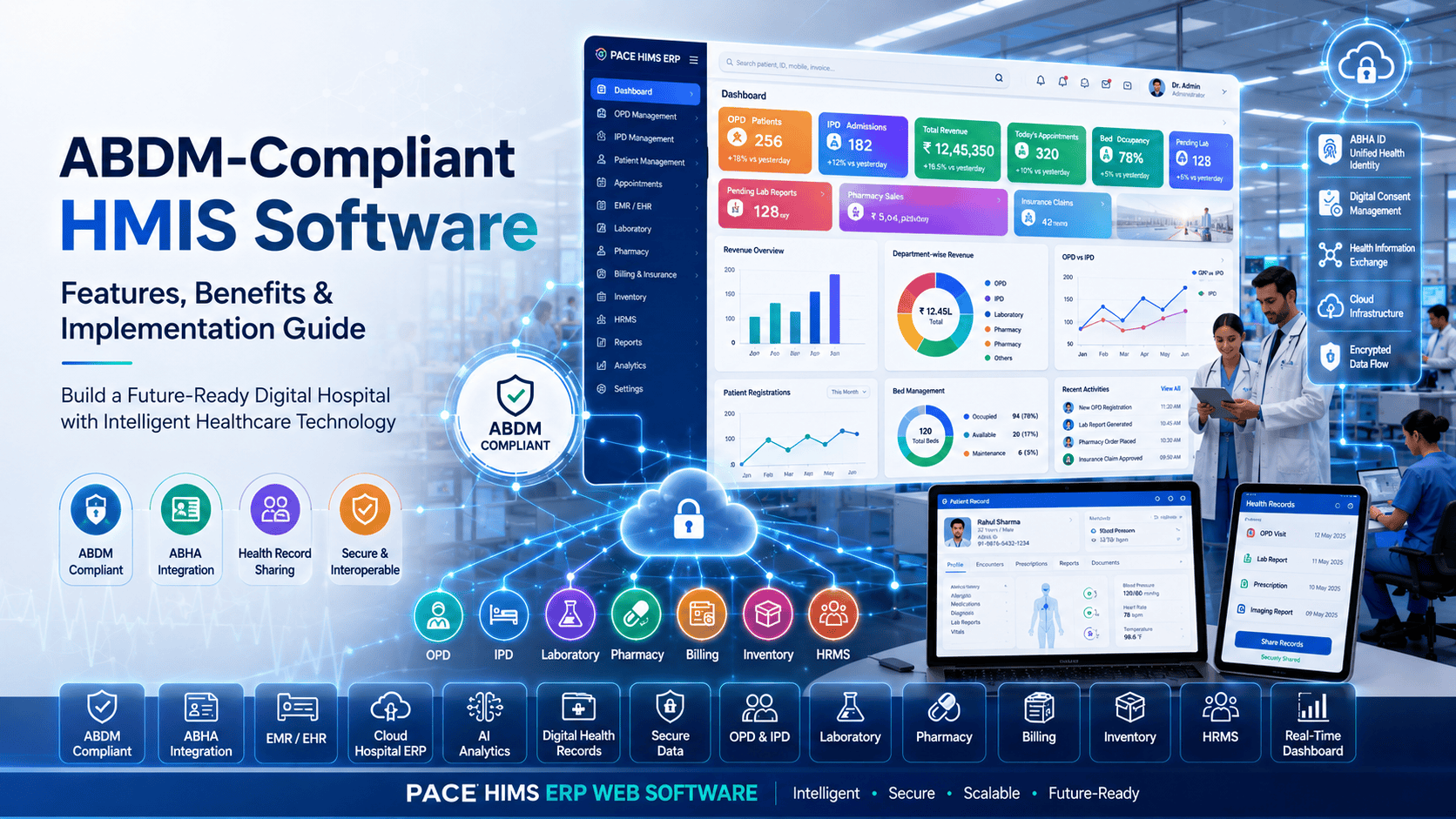
ABDM-Compliant HMIS Software: Features, Benefits & Implementation Guide

Healthcare in India is quickly transforming into a digital world because of the introduction of the Ayushman Bharat Digital Mission (ABDM). Because of the shift from manual record-keeping to the interconnected digitized system in hospitals, there is a great need to have quality HMIS Software Solutions. Today, patients want timely services, clear billing, and security of their records.

This innovation is no longer an option; it is an integral part of healthcare. By adopting ABDM Compliant Software, the hospitals will not only meet the national standards of health data but also run smoothly. The core of ABDM Compliant Software is HIMS Software that creates an integrated network of all hospital departments, starting from OPD till pharmacy.

What is Ayushman Bharat Digital Mission (ABDM)?

ABDM is the national initiative to develop a single health ecosystem in India. Its objective is to provide every citizen with a verifiable digital health identity, while also helping hospitals, clinics and diagnostic centres to securely exchange health information.

The main goals of the mission are to develop longitudinal health records, advance healthcare interoperability, and minimize duplication of diagnostic testing. ABDM integration for hospitals translates to quicker patient on boarding and lesser administrative burden.

For patients it means that their Digital Health Records are with them — from hospitals, cities, specialists — without duplicate paper records. With increasing number of facilities joining this network, India is closer to a true data-driven and connected healthcare future.

What is an ABDM-Compliant HMIS Software?

The Hospital Information Management System is a system developed with the standards and data exchange format established by the National Health Authority, which is compatible with the ABDRM standard. It is not just about digitizing healthcare processes, it is about linking them to the national digital health system.

This is done via ABHA (Ayushman Bharat Health Account) Integration, where each patient is connected with a unique Ayushman Bharat Health Account. The software is used for the management of consent based data sharing, so that patient data is shared only with the consent of the patient.

They also enable Health Information Exchange, which means sharing of Electronic Medical Records (EMR) and Electronic Health Records (EHR) between authorized parties, enhancing continuity of patient care and ensuring patient privacy.

ABDM Compliant HMIS Software

Essential Features of an ABDM-Compliant HMIS Software

ABHA Integration

Connects patients with their national health ID to facilitate easy access to patient records and sharing them with other institutions on the patient's consent.

Patient Registration

Streamlines OPD/IPD registration process using digital forms, minimizing waiting times and potential human errors.

OPD Management

Smoothes the appointment, consultation and prescription process for the outpatient departments.

IPD Management

Monitoring bed occupancy, ward transfer, summary of discharge for Inpatients.

EMR

Converts clinical notes, diagnoses, treatment notes for fast access by physicians.

EHR

Allows for a patient's entire medical history to be stored in one accessable digital file.

Laboratory Management

Automates test orders, sample tracking and report generation.

Pharmacy Management

Real-time drug inventory, prescriptions and expiry management.


Billing & Insurance

Invoices, Claims and Insurance Processing with minimal manual effort.


Inventory Management

Tracks medical equipment and supplies to ensure that there are not shortages or excess.


HRMS

It provides management of staff attendance, payroll and duty roster in one place.

Cloud-Based Access

Allows authorized personnel to access hospital information securely from anywhere.

AI powered analytics

Leverages predictive analytics to inform clinical and operational decisions.


Real-Time Dashboard

Provides the administrator with a real-time view of occupancy, revenue and performance.

Data Security & Compliance

Encrypts and restricts access to sensitive health data by different users.

Benefits of Implementing ABDM-Compliant HMIS Software

  • Enhanced patient care with instant access to full medical history records.
  • Less paperwork due to totally electronic registration and documentation.
  • Increased efficiency in the functioning of the hospital in OPD, IPD and diagnostics.
  • More efficient work of the doctors due to immediate access to EMR and lab results.
  • Instant reporting facility for the management to analyze their performance.
  • Enhanced decision-making process using accurate data and information.
  • Safe data management with encrypted infrastructure.
  • Conformity to ABDM as well as the nation’s health data standards.
  • Cost Savings through elimination of manual processes and duplicate tests.
  • Better patients experience in terms of reduced wait time and proper billing.
  • Multi-location management for hospital chains and multi-speciality groups.
  • Future-ready healthcare that scales with evolving digital health policies.

Step-by-Step Implementation Guide

  1. Assess hospital requirements – Identify departmental needs, patient volume, and existing gaps.
  2. Select the right HMIS Software – Choose a solution that is ABDM-compliant, scalable, and department-ready.
  3. Prepare IT infrastructure – Ensure adequate hardware, network, and cloud readiness.
  4. Data migration – Transfer existing patient records securely into the new system.
  5. Configure ABDM APIs – Enable ABHA creation, consent management, and health record linking.
  6. Staff training – Train doctors, nurses, and administrative staff on the new workflows.
  7. Testing – Run pilot testing across departments before full rollout.
  8. Go Live – Launch the system hospital-wide with support teams on standby.
  9. Monitor performance – Track usage, uptime, and user feedback closely.
  10. Continuous improvements – Regularly update modules based on evolving needs and ABDM guidelines.
  11.  

Common Challenges During HMIS Implementation

Hospital personnel usually encounter resistance when moving to new software because they are used to the old system that is paper based. Proper training and communicating the future gains will assist in overcoming this hurdle.

Migrating data from the old system may be difficult and can lead to errors. Hiring a company that has experience in migrating data to Cloud Hospital Software minimizes such risks.

The other issue is security due to the nature of the information involved. Selecting a secure software with robust encryption will help to handle this problem. Integration challenges of the new software with the lab and billing software are handled by proper budgeting.

How to Choose the Right ABDM-Compliant HMIS Software

When evaluating vendors, hospitals should check for:

ABDM Logo

Certified ABDM compliant software

Safe and reliable cloud deployment

Data security and role-based access

Data security and role-based access

End-to-end automation

Scalability to handle increasing patients’ loads

Mobile Healthcare Icon

Experience of vendors in healthcare technology

AI Icon

Integrated AI for data analytics and forecasting

Business intelligence dashboards

Reporting capabilities for all departments

Our Products Icon

Support services

Telemedicine

Access on mobile devices for doctors and other hospital personnel

Upgrades that go hand-in-hand with updates of ABDM

User-friendly interface

User-friendly interface

Why Healthcare Organizations Choose PACE HIMS ERP WEB SOFTWARE

Hospitals evaluating a long-term digital partner often look for proven experience alongside modern capability. PACE HIMS ERP WEB SOFTWARE brings over 25 years of healthcare technology experience to hospitals navigating this transition, combining domain knowledge with a modern, ABDM-compliant architecture.

Built as a Cloud Hospital Software platform, it supports ABHA Integration, enabling hospitals to onboard patients into the national digital health ecosystem smoothly. Its modules span OPD Management, IPD Management, EMR, EHR, laboratory information management, pharmacy management, billing and insurance, inventory management, and HRMS — all within a single, unified Hospital ERP.

For multi-speciality hospitals and hospital chains, PACE HIMS ERP WEB SOFTWARE offers multi-location support, letting administrators oversee operations across branches from one dashboard. AI-powered analytics and real-time dashboards give decision-makers timely, actionable insights, while robust security safeguards ensure patient records remain protected and ABDM-compliant.

As a scalable, enterprise-grade solution, it's designed to grow alongside a hospital's evolving digital healthcare needs.
Conclusion

Adoption of ABDM Compliant Software is not an upcoming thing anymore; it is now something that hospitals should consider for today, not tomorrow, if they wish to provide their patients with better, quicker, and transparent healthcare services. Contemporary HMIS Software integrates clinical, operational, and administrative processes into one to ensure creation of the connected hospital of the future.

With the growing digital healthcare industry of India, those hospitals which will choose the right technological partner are going to be successful in the future. Choosing PACE HIMS ERP WEB SOFTWARE is an effective way to create your hospital management system.

Frequently Asked Questions (FAQs)

ABDM Compliant Software is defined as software used in digital health that is compliant with the technical requirements of Ayushman Bharat Digital Mission in India for data exchange and ABHA-enabled health records.

This is software designed for the Hospital Information Management System and is compliant with ABDM guidelines and protocols for ABHA integration and consent-driven data exchange and digital health record exchange.

This is software that digitizes all functions of the hospital including Outpatient Department, Inpatient Department, lab, pharmacy, billing, human resources and more.

HIMS Software is different from others since it focuses on health information management that is compliant with national health data guidelines and standards.

Since PACE HIMS ERP WEB SOFTWARE offers ABDM compliant and cloud-based architecture with Artificial Intelligence in 25+ years experience in healthcare technology industry.