
Blogs
Hospital ERP Software: Features, Benefits & Buying Guide

Hospital ERP Software: Streamlining Hospital Operations with Integrated Healthcare Technology
A hospital never works in isolation. A single patient visit can involve the registration desk, a consulting doctor, the laboratory, the pharmacy, the billing counter and, often, a ward or operation theatre. Every one of these teams needs accurate information at the right moment.
When each department runs on its own software, or on registers and paper files, that information gets stuck. Staff re-enter the same details, reports reach doctors late, and management waits days for a consolidated view of revenue or stock.
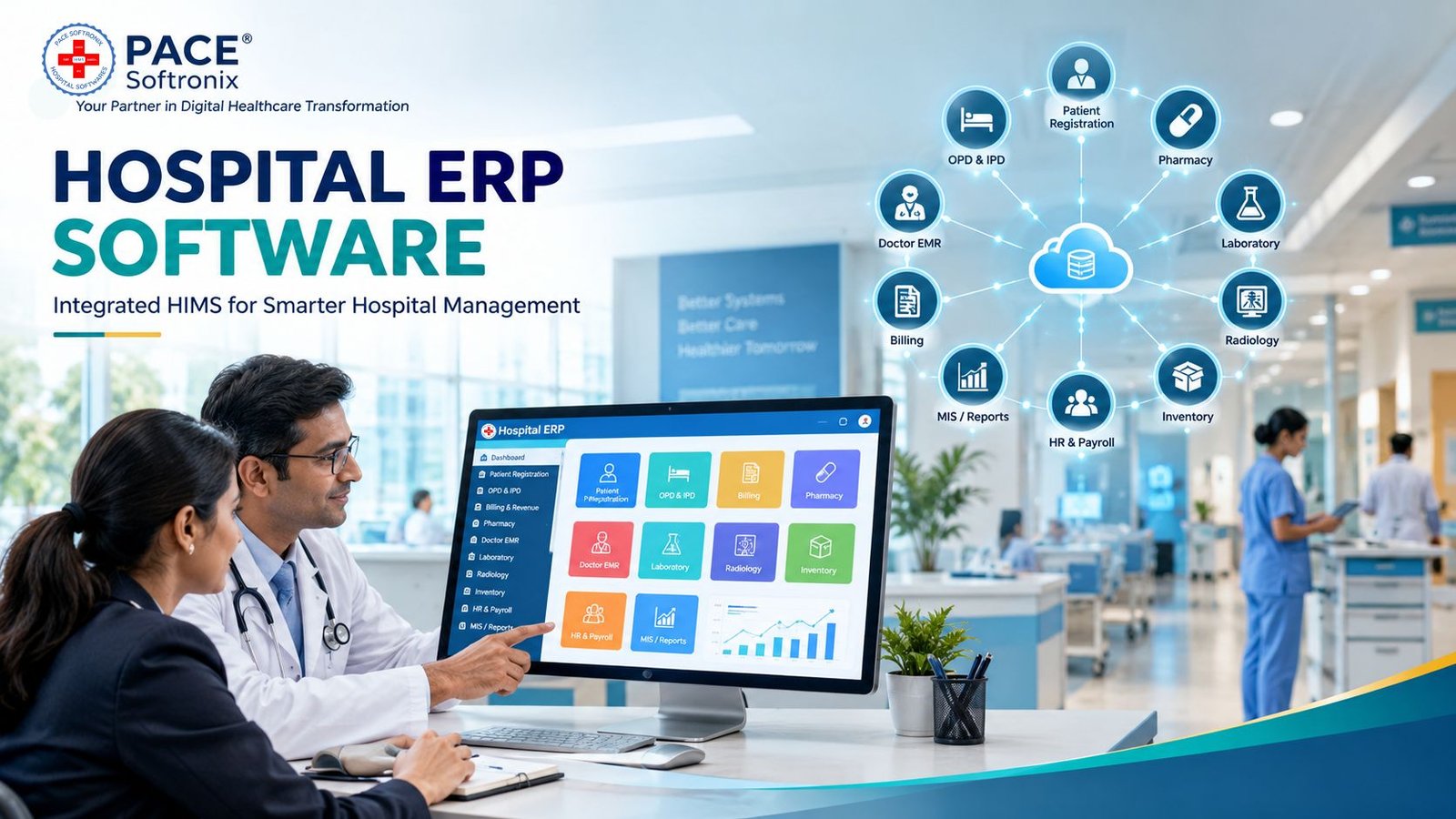
Hospital ERP Software addresses this by bringing clinical, administrative and financial work onto one connected platform. Many Indian hospitals already use HIMS Software for patient-facing workflows, and a HIMS ERP Software approach extends the same idea to stores, accounts, HR and management reporting. This article explains what such a system does, where it helps, and how to choose the right one.
What Is Hospital ERP Software?
Hospital ERP Software is an integrated suite of applications that manages the clinical and non-clinical functions of a hospital through a single database. ERP stands for enterprise resource planning, a concept long used in manufacturing and retail, adapted here for patient care. In the Indian context, HIMS ERP Software is the term commonly used for this kind of platform, where the hospital information management system (HIMS) sits at the core and ERP functions such as inventory, finance and HR are built around it.
How ERP differs from basic hospital management software
A basic hospital management system usually covers a few front-end tasks such as registration, appointments and billing. A complete hospital ERP solution goes further. It links those tasks with pharmacy, stores, laboratory, finance and human resources, so that a transaction in one area updates the others automatically.
Consider a simple example. A doctor prescribes a medicine. The pharmacy sees the order, stock reduces once it is dispensed, the charge reaches the patient's bill, and the accounts team sees the entry. Nobody types the same data twice.
Why centralised data matters
With one source of truth, every department sees the same patient record and the same numbers. A ward in-charge can check bed availability, a billing executive can see pending orders, and the medical superintendent gets an accurate picture of the day's patient load. Good HIMS Software is built around exactly this principle.
Why Hospitals Need an Integrated ERP System
Most day-to-day problems in hospitals trace back to disconnected tools. The common ones are:
- Duplicate data entry: Patient details are typed again at billing, pharmacy and the lab, which wastes time and invites errors.
- Information silos: Each department holds its own data, so no one has the full picture of a patient or of the hospital.
- Billing and revenue leakage: Services delivered but not billed, delayed insurance or TPA claims, and manual reconciliation make revenue hard to track.
- Inventory and pharmacy issues: Without live stock data, hospitals face stock-outs of critical drugs, expired items and excess purchasing.
- Manual reporting: Staff compile spreadsheets at month-end, and the numbers are already outdated when they reach management.
- Limited management visibility: Owners and administrators cannot easily compare departments, doctors or cost centres.
- Communication gaps: Lab results, discharge approvals and bed transfers depend on phone calls and paper slips.
Each issue may look manageable alone. Together, they slow down care and weaken financial control. A unified Hospital ERP Software platform removes the root cause instead of patching individual symptoms.
Key Modules and Features of a Modern Hospital ERP Solution
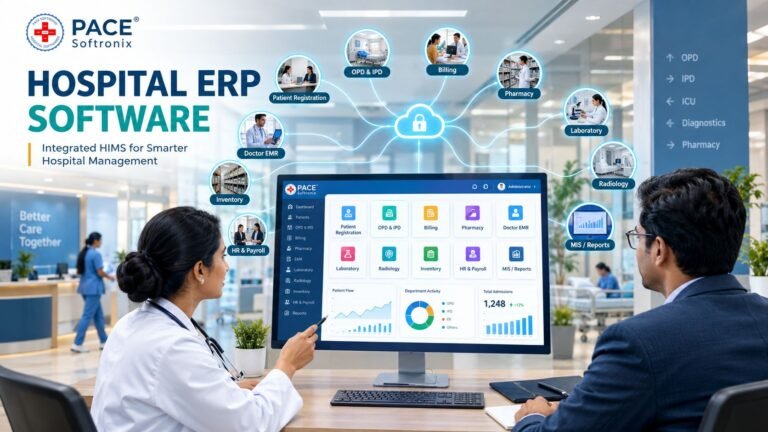
Not every hospital needs every module on day one, but it helps to know what each one does. A well-designed HIMS ERP Software platform typically covers the following areas.
Front-office and patient care
- Patient registration: Creates a unique patient ID once, so the same record is reused across OPD, IPD, lab and billing. This reduces duplicate records and long queues.
- Appointment management: Lets patients book slots by doctor and department, which smooths OPD flow and cuts waiting time.
- OPD management: Handles queues, consultation, prescriptions and follow-ups in one flow instead of several counters.
- IPD management: Tracks admission, bed allocation, transfers, nursing notes and ward billing so that inpatient status is always current.
- Doctor EMR: Gives doctors a digital record of history, diagnosis, prescriptions and investigation results, accessible whenever the patient returns.
- Discharge summary: Generates the summary from data already captured during the stay, so discharge is faster and more consistent.
Diagnostics and procedures
- Pathology and laboratory management: Sample collection, test orders, result entry and report delivery are tracked, and results flow straight into the patient's record.
- Radiology management: Manages imaging orders, scheduling and reports, reducing missed or delayed investigations.
- Operation theatre management: Helps schedule surgeries, allocate theatres and teams, and record consumables used for each procedure.
Billing, pharmacy and stores
- Billing and cash management: Captures charges as services are delivered, supports cash, card, insurance and TPA workflows, and reduces missed billing.
- Pharmacy management: Handles prescriptions, dispensing, batch and expiry tracking, returns and stock alerts.
- Inventory and materials management: Controls purchase requests, goods receipt, issue to departments and reorder levels across main store and sub-stores.
- Financial and revenue management: Links hospital transactions to accounts, helping finance teams track receivables, payables and department-wise revenue.
Administration and control
- HR and payroll: Covers staff records, attendance, shifts and salary processing for clinical and support teams.
- MIS and management reports: Provides dashboards and reports on footfall, occupancy, revenue and stock without manual compilation.
- User roles and access control: Makes sure each staff member sees only what their role requires, which protects patient privacy.
- Data security and backup: Regular backups, audit trails and access logs help protect sensitive health data and support continuity.
- ABDM-ready interoperability: Where applicable, support for Ayushman Bharat Digital Mission standards helps hospitals exchange health records in a structured, consent-based manner.
Because all these modules share one database, Hospital ERP Software lets information move between departments without re-entry or follow-up calls.
Benefits of HIMS Software for Hospitals
Hospitals that adopt HIMS Software thoughtfully tend to see practical gains in everyday work:
- Operational efficiency: Fewer repeated tasks means staff spend more time on patients.
- Centralised information: Records are stored in one place and are easier to find and verify.
- Less paperwork: Digital forms, prescriptions and reports reduce printing, filing and physical storage.
- Better coordination: Orders and results move between departments in real time.
- Faster billing: Charges are captured at the point of service, so the final bill at discharge is quicker and more accurate.
- Improved inventory control: Live stock data supports reorder alerts, expiry tracking and reduced wastage.
- Better decisions: Management can act on current reports rather than month-old summaries.
- Improved patient experience: Shorter queues, clearer bills and faster discharge make a visible difference to patients and families.
- Transparency: Audit trails show who did what and when, which supports accountability.
- Scalability: A modular system can grow with new departments, branches or specialties.
These gains build on each other. A hospital running HIMS ERP Software across clinical and back-office teams can connect a patient's treatment to its cost, which is difficult with separate tools.
Integrated HIMS ERP vs Standalone Hospital Applications
Many hospitals begin with separate tools for billing, pharmacy or lab. That can work at a small scale, but gaps appear as the hospital grows. The table below compares the two approaches.
Aspect | Disconnected applications | Integrated HIMS ERP Software |
Integration | Manual transfer or custom bridges between tools | Modules built to work together |
Data flow | Repeated entry, risk of mismatch | Single entry, shared record |
Reporting | Compiled by hand from several sources | Consolidated, near real-time reports |
Scalability | Each new tool adds complexity | Modules added to the same platform |
Administration | Multiple logins, vendors and upgrades | One user management and support channel |
Overall efficiency | Departments work in isolation | Coordinated workflows across departments |
Standalone tools are not necessarily poor. The issue is that they rarely share data cleanly. An integrated Hospital ERP Software platform is designed so that data flows once and is available everywhere it is needed.
How Integrated Healthcare Technology Supports Digital Transformation
Digital transformation in a hospital is not about buying computers. It is about replacing manual, disconnected processes with connected, trackable workflows. Hospital ERP Software is often the backbone of this shift.
- Real-time information: Bed status, test results and stock levels are visible when needed.
- Automation: Routine tasks such as charge posting, stock deduction and report generation happen automatically.
- Centralised records: Patient and administrative data are held in one secure system.
- Data-driven decisions: Trends in footfall, revenue and resource use guide planning.
Department integration: Clinical, financial and support teams work from the same information.
Cloud and on-premise deployment
Hospitals can choose between cloud and on-premise deployment, and the right choice depends on internet reliability, budget, in-house IT capability and data-policy preferences. Cloud setups reduce hardware management and ease multi-branch access. On-premise setups give direct control over servers and may suit hospitals with strong IT teams. Whichever is chosen, HIMS Software should come with clear backup, recovery and security practices.
How to Choose the Right Hospital ERP Software
Selecting a platform is a long-term decision, so a structured checklist helps. When evaluating Hospital ERP Software, consider:
- Hospital size and requirements: A 50-bed hospital and a multi-branch group have different needs.
- Required modules: List must-have modules now and those you may add later.
- Customisation: Check whether forms, reports and workflows can be adapted to your processes.
- Scalability: Confirm it can handle more users, beds and branches over time.
- Integration capabilities: Ask how it connects with lab machines, PACS, payment systems and other tools.
- Data security: Look for encryption, role-based access, audit logs and backup policies.
- User access control: Define permissions by role, department and location.
- Reporting and analytics: Review sample dashboards and request the reports your management uses daily.
- Vendor support: Understand support hours, response commitments and upgrade policy.
- Implementation and training: Ask for a clear rollout plan, data migration approach and staff training.
- Cloud or on-premise options: Match the deployment model to your infrastructure.
- Compliance and interoperability: Confirm alignment with applicable Indian regulations and ABDM requirements.
A practical tip: ask each vendor to demonstrate HIMS ERP Software using your own OPD, billing and pharmacy scenarios, and involve doctors, nurses and front-desk staff in the evaluation. Software that suits the people using it daily is more likely to succeed.
PACE Softronix Hospital ERP Solution
PACE Softronix Pvt. Ltd. is a healthcare technology company that provides hospital management and healthcare software solutions, including integrated HIMS/HMIS and ERP offerings. The aim is to help hospitals digitise operations, manage information and support better coordination between departments.
Through its Hospital ERP Software, hospitals can manage multiple functions on one platform, including:
- Patient registration, OPD and IPD management
- Billing and cash management
- Pharmacy and inventory
- Doctor EMR
- Laboratory and radiology
- HR and payroll
- MIS and reporting
- Hospital administration and user management
- Integration and interoperability capabilities
For hospitals comparing HIMS Software options, PACE Softronix can be a knowledgeable partner for understanding workflow needs before deciding on modules and deployment. Exact module scope, integrations and ABDM readiness are best confirmed through a demonstration and discussion based on your hospital's requirements.
Conclusion
As hospitals grow, managing patients, stock, staff and finances through separate tools becomes harder. An integrated approach gives every department the same information and gives management a clearer view of operations. That is why Hospital ERP Software is becoming a practical priority for multispecialty and mid-sized hospitals, as well as clinics planning to scale. The right HIMS ERP Software, backed by a dependable technology partner, can support long-term digital transformation without disrupting day-to-day care.
If you are a hospital administrator or decision-maker exploring HIMS Software, we invite you to explore PACE Softronix's hospital software solutions or request a demo to see how an integrated platform could fit your hospital.
Frequently Asked Questions (FAQs)
What is Hospital ERP Software?
Hospital ERP Software is an integrated system that manages clinical, administrative and financial functions, such as registration, billing, pharmacy, inventory, laboratory and HR, on a single platform with shared data.
How is HIMS Software different from a full hospital ERP?
HIMS Software mainly focuses on patient-related workflows. HIMS ERP Software combines these with back-office functions such as stores, finance and payroll, so clinical and administrative data stay connected.
Is an integrated system suitable for small hospitals and clinics?
Yes, provided it is modular. Smaller facilities can begin with core modules like registration, OPD, billing and pharmacy, and add others as they grow.
Should we choose cloud or on-premise deployment?
That depends on your internet reliability, IT resources, budget and data policies. Cloud suits multi-location access and low maintenance, while on-premise gives more direct control of infrastructure.
How long does implementation take?
There is no fixed timeline. It depends on the number of modules, data migration, customisation and staff training. A phased rollout, starting with high-impact departments, usually helps adoption.