
Blogs
ABDM-Compliant HMIS Software

HMIS Software and ABDM: Transforming Digital Healthcare Management in India
The Growing Need for Digital Healthcare Management
Walk into any busy hospital in India at 10 a.m. and you'll see the problem. Patients queue at registration, files move between departments, the billing desk waits on lab results, and the pharmacy checks stock on a separate register. Everyone is working hard, but the information isn't moving as fast as the people are.
This is why hospitals, clinics and diagnostic centres across the country are going digital. Better patient experience, tighter coordination between departments and clearer management information are now practical necessities. At the centre of this shift sits HMIS Software, also known as HIMS Software, which brings day-to-day hospital operations onto a single connected platform.
There's also a larger national picture. The ABDM, or Ayushman Bharat Digital Mission, aims to build a common digital backbone for healthcare in India. It rests on a simple idea: when health information is structured, secure and shared with the patient's consent, care becomes more connected for everyone involved. In this article, we look at how these pieces fit together and what hospital decision-makers should consider before choosing a solution.
What Is HMIS Software and Why Do Hospitals Need It?
HMIS stands for Hospital Management Information System. In plain terms, it is software that brings a hospital's administrative, clinical and financial activities into one place, so departments work from the same information instead of separate registers and spreadsheets.
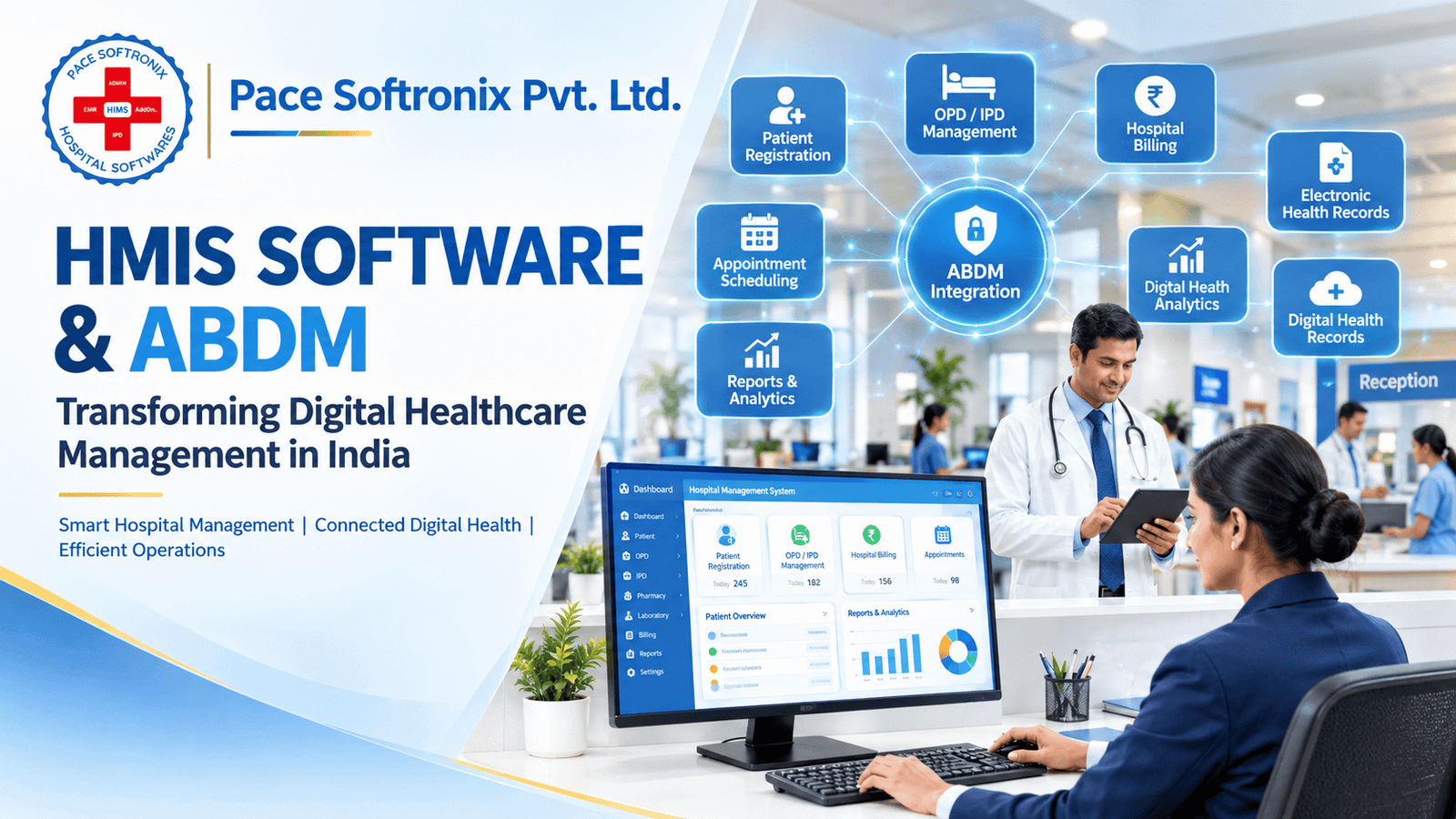
Depending on the solution, an HMIS can help manage:
- Patient registration and appointments: a single patient record from the first visit onwards.
- OPD and IPD management: consultations, admissions, bed allocation, transfers and discharge.
- Billing and payments: invoices, receipts, insurance or TPA-related workflows and financial records.
- Electronic Medical Records (EMR): clinical notes, prescriptions and patient history.
- Pharmacy and inventory: stock levels, issues and purchase tracking.
- Laboratory and diagnostics: test orders, results and report delivery.
- Reports and MIS: dashboards and management reports for administrators.
- Access control: role-based permissions so staff see only what they need.
The practical gain is less repeated data entry and easier access to information. When registration details flow into billing, and billing connects with the lab and pharmacy, staff spend less time re-typing and more time on patients. Administrators also get a clearer view of what is happening across the hospital, which helps them make better decisions.
One caveat: not every system includes every module. The capabilities you get depend on the software you select, so it's worth checking exactly what's included before you commit.
HMIS Software vs. HIMS Software: Is There a Difference?
Short answer: not really, at least not in everyday use. In the Indian healthcare industry, HMIS Software and HIMS Software (Hospital Information Management System) are used almost interchangeably. Some vendors prefer one term, some the other, and some say "Hospital Management Software" instead.
What matters far more than the acronym is what the product actually does. Does it fit your workflows? Is it easy for your front-desk staff and nurses to use? Can it grow with you? Does it integrate with the other systems you rely on?
So when you evaluate options, don't be swayed by the label. Ask for a demonstration, walk through your real processes (admission, billing, discharge) and see how the software handles them.
Understanding ABDM and Its Role in India's Digital Healthcare Ecosystem
The Ayushman Bharat Digital Mission is a national initiative to create an interoperable digital health ecosystem. Interoperability simply means that different healthcare systems can exchange information in a standard, secure way, rather than each one keeping data in its own silo.
A few concepts are worth knowing:
- ABHA (Ayushman Bharat Health Account): a unique health ID that patients can create to link their health records digitally.
- Digital health records: records that can be stored in structured formats and accessed when needed.
- Consent-based sharing: health information is shared only with the patient's permission, which keeps the patient in control.
- Standardised exchange: common formats and specifications that let participating systems "talk" to each other.
For patients, the potential benefit is having their records available across providers without carrying piles of paper. For hospitals and doctors, it means a fuller view of a patient's history, where the patient has chosen to share it.
Under the National Health Authority ABDM framework, the National Health Authority (NHA) is responsible for implementing and overseeing the mission. Hospitals that want to connect with the wider ABDM Health ecosystem need to meet applicable technical requirements, complete integration steps and follow consent and eligibility rules. Participation doesn't automatically unlock every digital health service, and not every HMIS product is ABDM-enabled by default. It's always sensible to check the latest guidance on the official NHA and ABDM resources.
How HMIS Software Can Support ABDM-Enabled Healthcare
It helps to be clear on one point: ABDM and HMIS Software are not the same thing. ABDM is the national digital health framework. An HMIS is the software a hospital uses to run its operations. The two meet when a hospital's software is built to work with ABDM's specifications.
An appropriately designed and integrated HMIS can help a hospital in several ways:
- ABHA-related workflows: creating or linking a patient's ABHA at registration, where the software supports it.
- Digital patient information: keeping records organised and structured, which is the foundation of any digital health exchange.
- Consent-aware sharing: making it possible to share records only when the patient has agreed.
- Interoperability with ABDM components: connecting with applicable ABDM building blocks through supported integrations.
- Less administrative friction: fewer paper forms and fewer duplicate records.
- Better departmental coordination: one source of truth for registration, clinical, lab and billing teams.
Whether your HIMS Software can do all of this depends on its implemented integrations, the current ABDM specifications, any approvals or certifications required, and how it's configured in your hospital. If ABDM readiness matters to you, ask the vendor specific questions and request a live walkthrough rather than relying on a brochure line.
Benefits of Choosing the Right HMIS Software Vendor
Buying hospital software isn't like buying a printer. You'll live with it for years, and your staff will use it all day. That makes the choice of an HMIS Software Vendor as important as the choice of product.
Here is a checklist worth keeping in hand:
Don't stop at the sales presentation. Ask for a product demo, understand the implementation plan, read the support terms and, if possible, speak with other healthcare users.
Why Healthcare Providers Should Invest in Modern HMIS Software
A good HMIS gives hospital leaders something that's hard to get from paper: visibility. You can see how patients are moving through the system, where bottlenecks form and how departments are performing. Patient administration becomes smoother, records stay organised and staff time is used more sensibly.
That said, the best software is the one that fits you. A 20-bed nursing home, a multispecialty hospital and a stand-alone pathology lab have very different needs. Think about your size, specialty, workflows, budget and expansion plans before you decide. And be wary of anyone who promises guaranteed savings or specific outcomes, because results depend on how the software is implemented and used.
Why Choose Pace Softronix Pvt. Ltd. for Healthcare Software Solutions?
Pace Softronix Pvt. Ltd. is a software company with more than 22 years of experience, and its healthcare solutions are designed to support hospital administration and day-to-day operational workflows. Depending on the solution, this includes areas such as patient registration, OPD/IPD management, billing, reporting and centralised information management, along with related hospital administration modules.
For healthcare organisations evaluating HMIS Software or HIMS Software, Pace Softronix aims to be a practical, dependable technology partner, with software that is straightforward to use and support that understands how hospitals work. If ABDM-related capabilities are on your list, we'd encourage you to raise them during a demonstration so you can see what's currently available and how it fits your needs.
You can explore the available solutions and request a product demonstration at www.pacesoftronix.com.
Building a Smarter Digital Healthcare Future
India's healthcare sector is moving steadily towards connected, data-driven care. For hospitals and clinics, that journey starts with choosing the right HMIS Software, understanding what ABDM means for your organisation, and working with a reliable HMIS Software Vendor who can explain, implement and support the solution honestly.
Technology alone won't do it. Successful digital transformation combines the right software, secure handling of patient information, appropriate integrations and a well-planned rollout with trained staff.
If you're considering a move to digital hospital management, we invite you to connect with Pace Softronix Pvt. Ltd. to explore hospital management software that suits your organisation.