
Blogs
HIMS Trust Hospital ERP Software

HIMS Trust Hospital ERP Software : Balancing Affordable Care with Operational Efficiency
Operating a charity or trust-sponsored hospital is totally different from operating an organization-owned hospital. The trust hospitals work with two-fold responsibilities – delivering excellent, mostly subsidized or free medical care to underprivileged areas and ensuring strict financial controls over their donations, grants, and subsidies.
As patient numbers increase along with stricter compliance requirements in India, paper-based processes result in massive hindrances. In order to continue fulfilling their mission, it is important for charity hospitals to digitize themselves. This can be done through a comprehensive HIMS Trust Hospital ERP Software that enables them to streamline processes, prevent financial leakage, and concentrate their efforts in the right direction.
Understanding the Unique Structure of Trust Hospitals
Trust hospitals, missionary medical centers, and NGO-backed clinics form the backbone of affordable healthcare in both urban and rural India. Unlike corporate hospitals driven by profit margins, trust hospitals prioritize community welfare. They frequently offer tiered pricing, heavy concessions, and free treatments funded by corporate social responsibility (CSR) grants, individual donors, and government healthcare schemes like Ayushman Bharat (PM-JAY).
Because their funding is tied directly to social impact, these institutions must account for every single rupee spent. This requires an extraordinary level of operational transparency that traditional ledger books or disjointed legacy software simply cannot provide.
Core Administrative Challenges in Charitable Healthcare
The lack of automation systems creates severe weaknesses in a trust-based healthcare system:
Invisible Donations Linking
It is hard to link a certain donation to a specific surgery of the patient or equipment within the ward manually.
Revenue Loss in Billing
Manually managing different concession systems, discount levels, and government schemes usually causes incorrect billing and losses.
Lack of Control Over Inventory
The manual approach towards inventory management results in the spoilage of pharmaceuticals or shortage of drugs and equipment.
Legal Obligations
The trust facilities undergo comprehensive audits. Preparing compliant financial reports for tax exemptions and government agencies is extremely time-consuming.
The Strategic Role of a HIMS Trust Hospital ERP Web Software
Digital transformation is no longer a luxury reserved for high-end corporate chains. Transitioning to a modern HIMS Trust Hospital ERP Web Software system bridges the gap between limited financial resources and exceptional clinical delivery.
By unifying all operations under a single web interface, administrators can seamlessly track a patient’s journey from the front desk to final discharge. Because the platform runs directly inside a secure web browser, doctors, nurses, and financial auditors can access real-time information from any authorized device. This centralized data model ensures that clinical choices and administrative approvals happen in tandem, significantly lowering patient wait times and preventing administrative errors.
Why Cloud-Based HIMS Software for Trust Hospitals is the Ideal Choice
For an institution running on public or charitable funds, capital expenditure (CapEx) must be kept to an absolute minimum. This reality makes a Cloud based HIMS software for Trust Hospitals the most practical and sustainable choice.
- Zero Expensive Server Hardware: Cloud hosting eliminates the need for expensive on-site server rooms, specialized cooling systems, and dedicated IT infrastructure teams.
- Flawless Multi-Branch Control: If your trust runs a main hospital along with secondary rural clinics, a cloud system unifies them instantly. Executive teams can monitor multi-branch operations, transfer inventory between locations, and review unified financial analytics from a single dashboard.
- Enterprise-Grade Security: Patient electronic health records (EHR) and financial ledgers are protected by continuous backups and sophisticated role-based data encryption, keeping your facility compliant with evolving digital health regulations in India.
Platforms like the PACE Cloud HIMS deliver these exact cloud benefits, ensuring small-to-large trust networks scale their software seamlessly without heavy upfront IT investments.
Key Modules: Driving Clinical Excellence and Financial Transparency
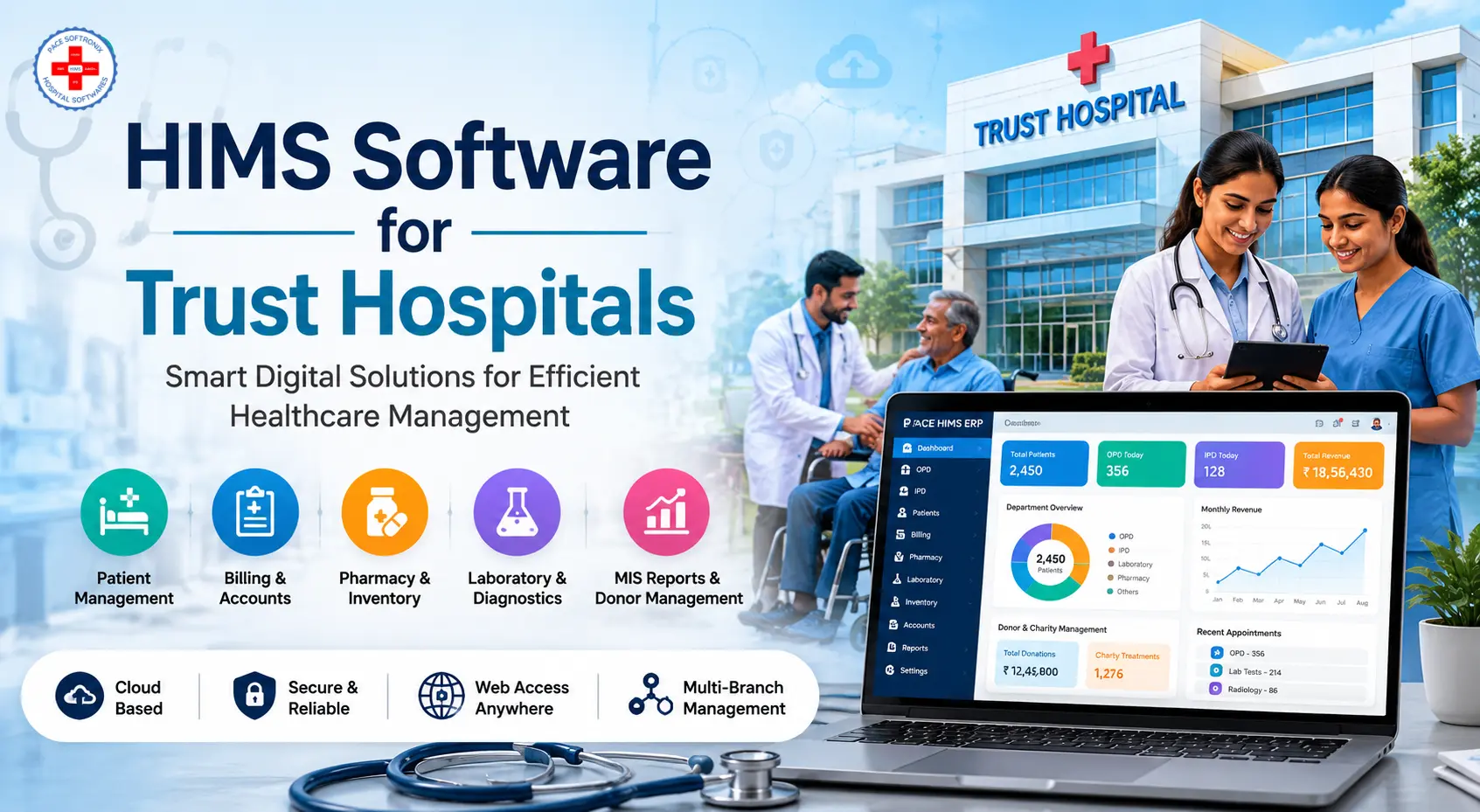
An enterprise-grade platform must support both the medical staff on the floor and the trustees in the boardroom. The PACE Hospital ERP framework does this by connecting key operational modules:
OPD and IPD Automation
Simplify high-volume patient registration with smart token generation. The system manages admissions, bed allocations, transfer requests, and nursing documentation seamlessly. This significantly reduces the administrative workload on your clinical team.
Electronic Medical Records (EMR)
Centralize patient histories, allergy alerts, past diagnoses, and treatment plans. This quick access to clinical data protects patient safety and ensures continuity of care across different consultants.
Dynamic Billing, Pharmacy, and Laboratory Integration
When a physician updates a patient's EMR, the prescription automatically goes to the pharmacy, and diagnostic requests immediately appear in the lab queue.
- Billing: The central billing system automatically applies the correct discounts or scheme rules based on the patient's registered trust category.
- Inventory Control: The pharmacy and main store use batch tracking and automated reorder triggers to maintain optimal stock levels, preventing excess capital from being tied up in overstocked inventory.
Comprehensive MIS Reports and Audit Trails
Create instant Management Information System (MIS) reports to track daily collections, bed occupancy trends, and departmental expenses. Each adjustment, discount, or medication issue leaves a permanent digital record, providing a reliable audit trail for board meetings and regulatory reviews.
Why Indian Trust Hospitals Partner with PACE Softronix
Deploying healthcare software successfully requires a partner who understands clinical operations completely. PACE Softronix specializes in creating effective, easy-to-use solutions that fit your hospital's specific workflows instead of making you change them.
With targeted implementations like PACE HIMS ERP Software, institutions can manage complex trust concession matrices, organize specific donor funding pools, and streamline high-volume outpatient queues. For large, multi-specialty trust networks needing a higher level of automation, PACE Trust Hospital Management Software provides the exact operational control necessary to reduce waste and increase your impact in the community.
Conclusion: Empowering Your Mission Through Automation
The true measure of a trust hospital’s success is the volume of lives it positively impacts. By replacing slow, fragmented manual tasks with a modern, integrated HIMS Trust Hospital ERP Software, your facility can safeguard its financial resources, deliver completely transparent donor reporting, and significantly elevate patient care standards.
Don't let legacy administrative workflows hold back your healthcare mission. Move your institution into the digital age with a platform built for modern healthcare delivery.
Transform Your Hospital Operations Today
Take the first step toward comprehensive hospital digitization and airtight financial control. Contact the enterprise healthcare deployment experts at PACE Softronix today.
Request a Free Demo:
See PACE HIMS live in action, tailored to your specific clinical workflows.
Expert Consultation:
Speak with our healthcare IT specialists about structural optimization and phased Cloud ERP implementation
FAQs
While a regular ERP concentrates mainly on earning profits and revenues from insurance, a trust-oriented ERP has special modules for donor management, CSR grant tracking, multi-level patient discount management, government welfare scheme administration, etc., making it absolutely transparent when it comes to financial audits.
Absolutely. Using a web-based system or the PACE Cloud HIMS system, the administrator can keep track of multiple locations physically, maintain centralized inventory and finances of all the locations, and also view financial statements for the organization from a single dashboard.
This software assigns every donation or grant made to a particular department or fund or even a specific patient treatment. This will enable you to create usage reports for each donor showing him/her how their donation has been utilized.
Not at all. Modern solutions are built with intuitive, user-friendly interfaces designed for doctors, nurses, and billing staff who may not be tech experts. Because the system is web-based, your staff accesses it just like a regular website, keeping learning curves short.
When clinical services, laboratory tests, and pharmacy orders are connected directly to a patient's central profile, every charge is logged automatically. The system calculates pricing based on predefined trust discount rules, completely removing human calculation errors and unauthorized manual modifications.
Yes. During the digitization process, data migration experts work closely with your team to securely extract, clean, and upload your legacy patient data and master inventory records into the new system, ensuring uninterrupted clinical operations.